Basics: Colouring your Icing
By HomeBakers Team
– By Akhileshwari Anand Raj
How to use food colouring to get ANY colour that you need!
Food colouring is a great ingredient in baking – it makes everything come to life, and in the best way possible! Right from your base cakes in a rainbow cake, to colouring your buttercream for ombre or pastel effect, colouring agents are really important. However, some colours are very easy to achieve and some are elusive. Light pastel colours are very easy to achieve since a little bit of colour goes a long way. Deeper colours are a huge problem – getting the perfect black is an art itself. Red which is commonly used in red velvet is also hard to achieve. The biggest problem, however, is when you need a colour for which food colours are not commonly manufactured. Think skin tones, colours that are not primary colours, and certain specific shades of uncommon colours.
This is where the good old Colour Wheel comes into play. Colour wheels and colour charts are not just for art; they are of great use when you want to get a particular colour that you can’t find easily in stores, or even when you want a small batch of it. Food colouring can be mixed in different proportions for different results. This article will deal with how to colour both fondant and buttercream, to help decorate your cake in a whole new way!
Let’s quickly talk about the medium of food colouring. In baking, there are three commonly used kinds of food colouring – liquid, gel and powder-based colours. This article is going to work only when you are using liquid or gel/oil-based colours. The powder as a medium is challenging to work with as it is, and trying to mix it will not yield any worthwhile result.
How to start mixing?
Always start by looking at a colour chart to figure out what your exact proportions of colour have to be. It is definitely a good investment to purchase one to keep in handy. You could also print one off the internet, but make sure that it is reliable. Start with the colour with a higher proportion in your mixture, and then add the other colour in smaller quantities. If you are trying a particular colour for the first time, it is always better to try it in smaller batches and to go slow. Ensure that you take the liberty to experiment – results may vary from brand to brand and it is best to find what works perfectly for you! To keep things very accurate, you could use a kitchen scale to measure out how much of each colour you have added. This will help you in the future to recreate the same colour.
How to use this effectively for decorating
Once you are sure of the proportions that work for you and the colours that you have to use, use this to create a much larger batch. The reason why? It is very hard to recreate a colour by mixing, so it is better to make a large batch. Make sure that it is enough to decorate your cake or cupcakes (or any other bakes).
For both fondant and buttercream, mix in the colour a day before you use it if you want the pigment to be richer and darker. This works best for many dark colours but isn’t the best for pastel colours. Colours like black are best mixed a few days ahead of use as it will intensify over time. When you are going to let the icing sit, make sure you don’t over- colour the icing before storing it overnight or for a few days.
For buttercream – make sure that you finish decorating your cake with the mixed colour on the same day because the remaining colour will darken if you let it sit overnight. Then there will be the issue of different shades on the same cake.
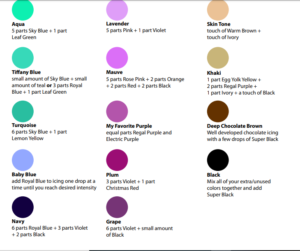
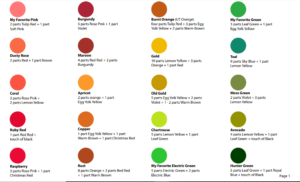
This colour chart below is comprehensive and use this as a reference to get started! (credits – Sweet Sugar Belle).
Use this article as a primer into your world of colour mixing, and explore your own methods and proportions. Hope this helps you! If you are interested in starting your own home baking business or want to learn more about the different strategies that go into it, check out our article on **how to become a home baker**.